These programs are high-integrity mathematical software. The standard production versions do not include graphics, for portability and to make it easier to run the programs as part of batch processes. However, the output is suitable for reading into most spreadsheets or programs such as GNUPLOT. Versions with built-in graphics are available for a restricted set of platforms - please enquire for more information.
| Executable programs: | ||
|---|---|---|
| Source code: |
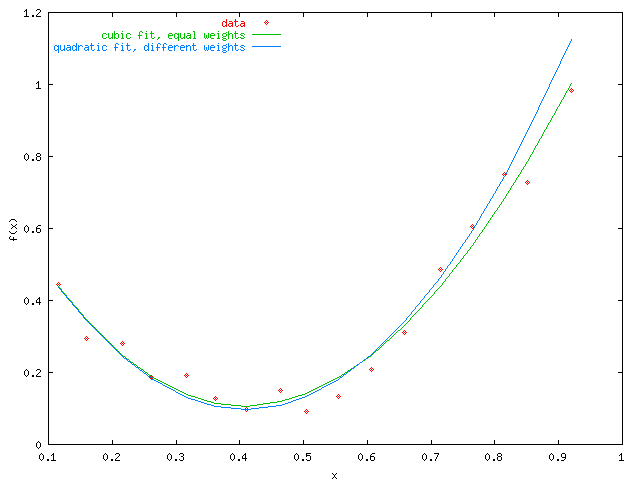
The program calculates the fitting coefficients, the residual of the fit (sum of squares of deviation from each point), the determinant of the fitting equation (indicating when the fitting process may run into trouble if the problem is ill-conditioned) and the deviation in each point.
Here is an example of the results of polynomial fitting with and without weights, and plotted using GNUPLOT:
The program calculates the fitting coefficients, the residual of the fit (sum of squares of deviation from each point), the determinant of the fitting equation (indicating when the fitting process may run into trouble if the problem is ill-conditioned) and the deviation in each point.
Allowable functions include any of the Realfunction1d class
in the WSTS C++ maths library.
Here is an example of the results of the fitting program, plotted using GNUPLOT:
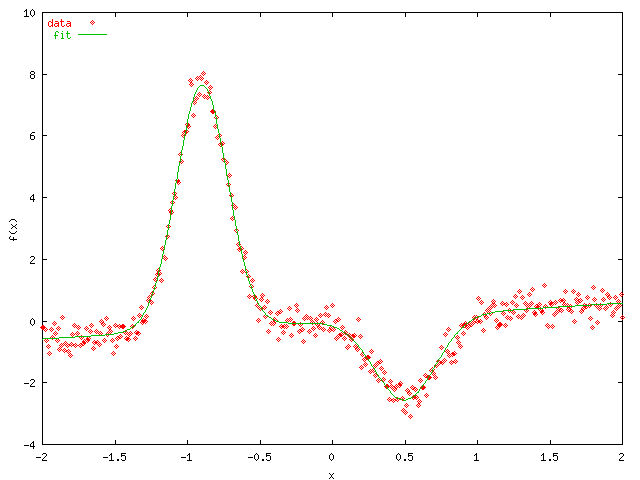
The program calculates the fitting coefficients, the residual of the fit (sum of squares of deviation from each point), the determinant of the fitting equation (indicating when the fitting process may run into trouble if the problem is ill-conditioned) and the deviation in each point.
Allowable functions include any of the Realfunctionnd class
in the WSTS C++ maths library.
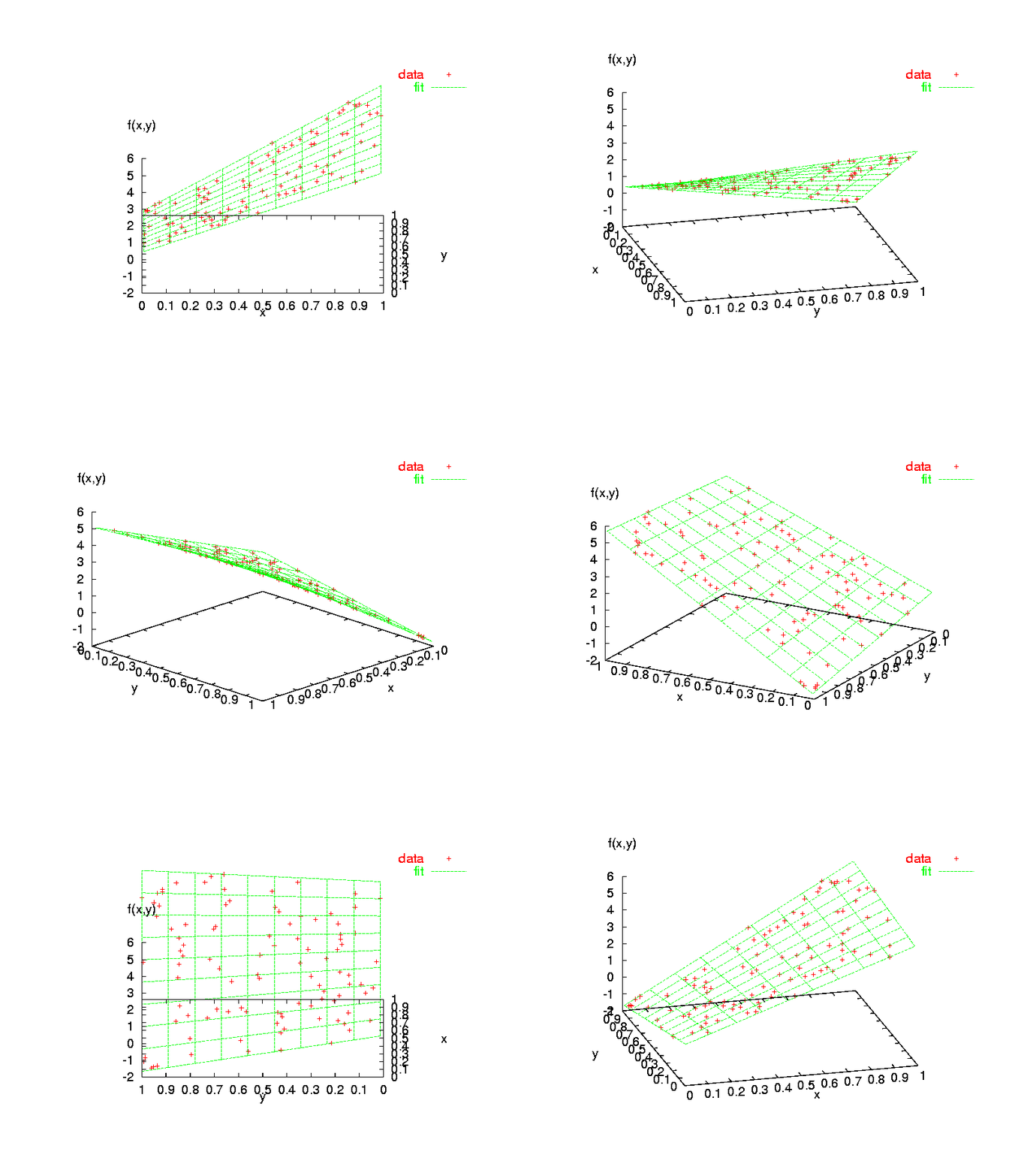
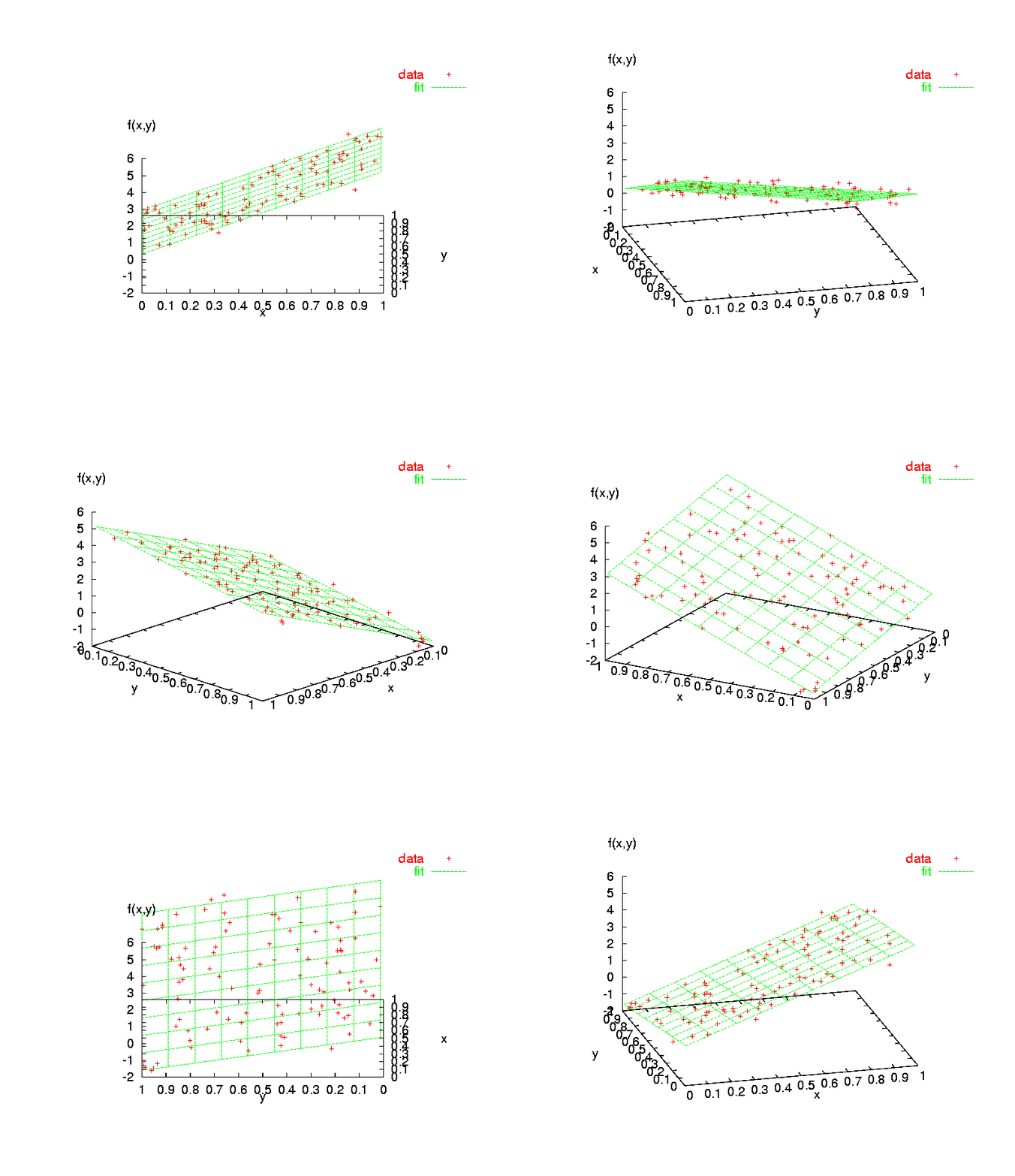
For an animated example of the results of the fitting program, plotted using GNUPLOT, click here (191 kb).
The program calculates the fitting coefficients, the residual of the fit (sum of squares of deviation from each point), the determinant of the fitting equation (indicating when the fitting process may run into trouble if the problem is ill-conditioned) and the deviation in each point.
UNIX batch files are also included to connect the programs together for use with any external model, e.g. a continuum mechanics calculation. (The programs can be used on any platform, but corresponding batch files will beed to be written if UNIX is not available.)
The program takes as input two functions, f and g say, described as tables. If asked to convolve the functions, the program calculates f*g. If asked to deconvolve the functions, the program takes f as being h*g for some function h, which it calculates.
The input data specifies a surface within which all points are to lie,
and a range for each spatial coordinate over which to look for candidate
points.
Allowable surfaces include any of the Surface class
in the WSTS C++ maths library.
The density function is the probability that any candidate point will be
accepted. (Values greater than or equal to 1 are always accepted.)
Allowable functions include any of the Realfunctionnd class
in the WSTS C++ maths library.
The input data specifies a set of functions and the amplitude for each, and a noise function with amplitude and offset.
Allowable functions include any of the Realfunction1d class
in the WSTS C++ maths library.
Allowable random number generators include any of the
Random_number_generator class
in the WSTS C++ maths library.
The offset and amplitude functions allow the noise properties to be
varied with position.
The input data specifies a set of functions and the amplitude for each, and a noise function with amplitude and offset.
Allowable functions include any of the Realfunctionnd class
in the WSTS C++ maths library.
Allowable random number generators include any of the
Random_number_generator class
in the WSTS C++ maths library.
The offset and amplitude functions allow the noise properties to be
varied with position.
The program calculates the parameters of the plane (its normal vector and family parameter) and the deviation of each data point from the fit. The program operates in any number of space dimensions.
For an animated example of the results of the fitting program, plotted using GNUPLOT, click here (184 kb).
The program calculates the parameters of the sphere (its centre and radius), and operates in any number of space dimensions.
The program calculates the parameters of the ellipsoid (its centre and half-axes), and operates in any number of space dimensions. The principal axes of the ellipsoid are parallel with the coordinate directions.
The centre of the ellipsoid may be defined by the user, or calculated by a (weighted) average of the points.
The program calculates the parameters of the ellipsoid (its centre and half-axes), and operates in any number of space dimensions. The half-axes are expressed in terms of the axis vectors: if these are not unit vectors then the half-axes will vary with the length chosen.
The centre of the ellipsoid may be defined by the user, or calculated by a (weighted) average of the points.